


Canada has a typical immigration process similar to that of most Anglo-sphere nations. One acquires a visa through economic programs like express entry, family-related visas like spousal sponsorship, or via refugee programs. The visa provides temporary residency and work authorization, and if not immediately providing permanent residency will usually provide a path to convert to permanent residency, and after meeting requirements for naturalization as a permanent resident, including residence of at least 1095 days over a 5-year period, language and citizenship tests, evidence of payment of taxes during the residence period, etc., one can apply for citizenship. Canada also has provisions for children born abroad to Canadian citizens, though this has historically been limited to the first generation born abroad unless the parent also meets residence requirements as an adult prior to the birth of the child. It’s not citizenship by ancestry or descent in the sense that many European nations have jus sanguinis provisions in their laws, but more similar to transmission of US citizenship through consular birth abroad registration.
However, this was true only up until December 19, 2023. On that day, the Ontario Superior Court of Justice ruled in the case Bjorkquist et. al. versus Attorney General of Canada that certain provisions of the Canadian citizenship act, primarily the first generation limit, were in contravention to the Canadian Charter of Rights and Freedoms. In order to prevent a free-for-all of Canadian citizenship claims, the court and Immigration, Refugees, and Citizenship Canada (IRCC) reached an agreement on the implementation of an interim measure to redress violations of citizens’ rights and a stay on overturning the first generation limit was issued. The interim measure makes use of offers of citizenship grants under subsection 5(4) of the Citizenship Act, which allows for citizenship by exception. Lines of descent are being evaluated with extreme generosity, and people five or six generations removed from their last born Canadian ancestor are reporting acquisition of Canadian citizenship through this method. This stay remains in effect to this day and the interim measure is at least officially still in place, though appears to be functionally closed as of this date.
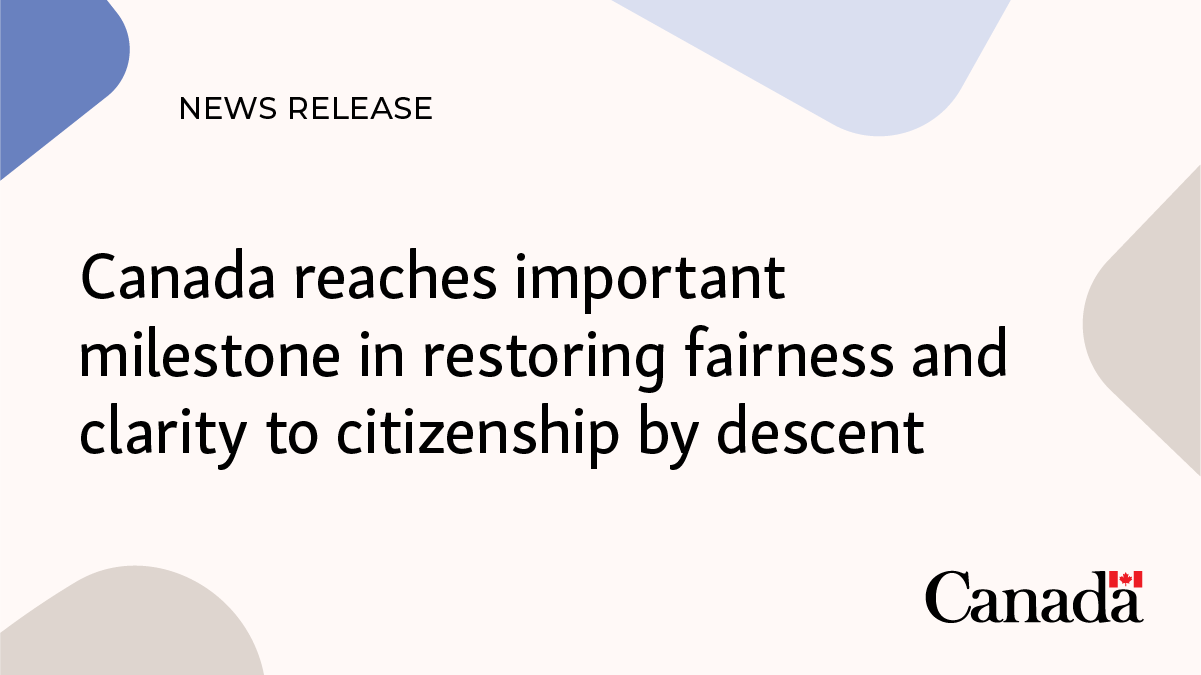
The Canadian parliament has attempted to pass modifications to the Citizenship Act since early 2024, starting with bill C-71, which was invalidated due to the fall of the Trudeau government and subsequent elections, and continuing with the re-introduction of the provisions in bill C-3 after the spring 2025 general election. Passage of C-3 appears to be imminent and one can expect it will gain royal assent this autumn. This bill would broaden eligibility for Canadian citizenship by ancestry to the second generation without substantial presence requirement, and allow transmission to subsequent generations if the substantial presence requirement is met by a parent. There are some additional edge cases that must be parsed once the bill is finalized and passed in the Canadian Senate. However, the general import is that transmission of Canadian citizenship through parentage will be more generous than the previous first generation limit. After assent, applications will no longer be processed under the interim measure. However, as of today, the court-imposed stay and interim measure are officially still in effect, though it appears that new 5(4) offers are no longer being issued.
I discovered this situation and applied via the interim measure process in early 2025 and received my Canadian citizenship this year using the steps described below.
First, identify your last Canadian-born ancestor and acquire all documentation. Canada requires color copies of certified birth certificates for the entire chain of descent. It is particularly important to obtain a certified birth record for the Canadian-born ancestor. Collections of other certified records, like marriage licenses, census records, or death certificates can sometimes be used for non-Canadian ancestors if birth records are not available. My ancestor was born in Canada in the mid-1800s and emigrated prior to 1900. Document collection cost $55 USD.
Second, complete a Canadian proof of citizenship form stating that you think you might be a Canadian citizen but are not sure. Provide photographs in the Canadian PR format, proof of payment of the citizenship fee, a cover letter explaining your chain of descent, and copies of all collected documents. IRCC will review the documents and, if acceptable, will move to the next step. They will in some cases request additional information if they deem it necessary. This step cost the citizenship proof fee of $75 CAD, about $20 USD for photographs and miscellaneous printing fees, and courier fee of around $80 USD for shipping the paper application materials.
If your proof application is complete, IRCC will email you stating that you are not a Canadian citizen due to the first generation limit, but due to changes in Canadian citizenship law, they are authorized to offer you a citizenship grant under subsection 5(4). To apply for this grant, you must email a withdrawal request for the proof application, a letter requesting consideration under 5(4), more photographs in the Canadian PR format, a form stating that you have committed no crimes or acts of terrorism, proof of payment of a citizenship application fee, and a police certificate from your country of residence. This step cost $119 CAD for the application fee and about $60 USD for assorted paperwork costs. Note that sometimes they will refund the proof of citizenship fee once the proof of citizenship request is withdrawn, but that this is not guaranteed to happen.
This application will be processed for a while, but eventually, you will see your proof application marked withdrawn and the citizenship application marked as decision made. A few weeks later, you’ll receive an invitation to a virtual citizenship ceremony conducted via Zoom, at which your Canadian citizenship will be finalized after swearing the oath of citizenship.
The entire process required 1 month of document collection and 5 months of processing time to complete, and cost $365 USD in total. I was not required to travel to Canada during the process. You must have ancestral ties to Canada, though the ties can be quite distant. It beats the hell out of Dominica or Sao Tome and Principe as a second citizenship if you are eligible.
However, this was true only up until December 19, 2023. On that day, the Ontario Superior Court of Justice ruled in the case Bjorkquist et. al. versus Attorney General of Canada that certain provisions of the Canadian citizenship act, primarily the first generation limit, were in contravention to the Canadian Charter of Rights and Freedoms. In order to prevent a free-for-all of Canadian citizenship claims, the court and Immigration, Refugees, and Citizenship Canada (IRCC) reached an agreement on the implementation of an interim measure to redress violations of citizens’ rights and a stay on overturning the first generation limit was issued. The interim measure makes use of offers of citizenship grants under subsection 5(4) of the Citizenship Act, which allows for citizenship by exception. Lines of descent are being evaluated with extreme generosity, and people five or six generations removed from their last born Canadian ancestor are reporting acquisition of Canadian citizenship through this method. This stay remains in effect to this day and the interim measure is at least officially still in place, though appears to be functionally closed as of this date.
The Canadian parliament has attempted to pass modifications to the Citizenship Act since early 2024, starting with bill C-71, which was invalidated due to the fall of the Trudeau government and subsequent elections, and continuing with the re-introduction of the provisions in bill C-3 after the spring 2025 general election. Passage of C-3 appears to be imminent and one can expect it will gain royal assent this autumn. This bill would broaden eligibility for Canadian citizenship by ancestry to the second generation without substantial presence requirement, and allow transmission to subsequent generations if the substantial presence requirement is met by a parent. There are some additional edge cases that must be parsed once the bill is finalized and passed in the Canadian Senate. However, the general import is that transmission of Canadian citizenship through parentage will be more generous than the previous first generation limit. After assent, applications will no longer be processed under the interim measure. However, as of today, the court-imposed stay and interim measure are officially still in effect, though it appears that new 5(4) offers are no longer being issued.
I discovered this situation and applied via the interim measure process in early 2025 and received my Canadian citizenship this year using the steps described below.
First, identify your last Canadian-born ancestor and acquire all documentation. Canada requires color copies of certified birth certificates for the entire chain of descent. It is particularly important to obtain a certified birth record for the Canadian-born ancestor. Collections of other certified records, like marriage licenses, census records, or death certificates can sometimes be used for non-Canadian ancestors if birth records are not available. My ancestor was born in Canada in the mid-1800s and emigrated prior to 1900. Document collection cost $55 USD.
Second, complete a Canadian proof of citizenship form stating that you think you might be a Canadian citizen but are not sure. Provide photographs in the Canadian PR format, proof of payment of the citizenship fee, a cover letter explaining your chain of descent, and copies of all collected documents. IRCC will review the documents and, if acceptable, will move to the next step. They will in some cases request additional information if they deem it necessary. This step cost the citizenship proof fee of $75 CAD, about $20 USD for photographs and miscellaneous printing fees, and courier fee of around $80 USD for shipping the paper application materials.
If your proof application is complete, IRCC will email you stating that you are not a Canadian citizen due to the first generation limit, but due to changes in Canadian citizenship law, they are authorized to offer you a citizenship grant under subsection 5(4). To apply for this grant, you must email a withdrawal request for the proof application, a letter requesting consideration under 5(4), more photographs in the Canadian PR format, a form stating that you have committed no crimes or acts of terrorism, proof of payment of a citizenship application fee, and a police certificate from your country of residence. This step cost $119 CAD for the application fee and about $60 USD for assorted paperwork costs. Note that sometimes they will refund the proof of citizenship fee once the proof of citizenship request is withdrawn, but that this is not guaranteed to happen.
This application will be processed for a while, but eventually, you will see your proof application marked withdrawn and the citizenship application marked as decision made. A few weeks later, you’ll receive an invitation to a virtual citizenship ceremony conducted via Zoom, at which your Canadian citizenship will be finalized after swearing the oath of citizenship.
The entire process required 1 month of document collection and 5 months of processing time to complete, and cost $365 USD in total. I was not required to travel to Canada during the process. You must have ancestral ties to Canada, though the ties can be quite distant. It beats the hell out of Dominica or Sao Tome and Principe as a second citizenship if you are eligible.